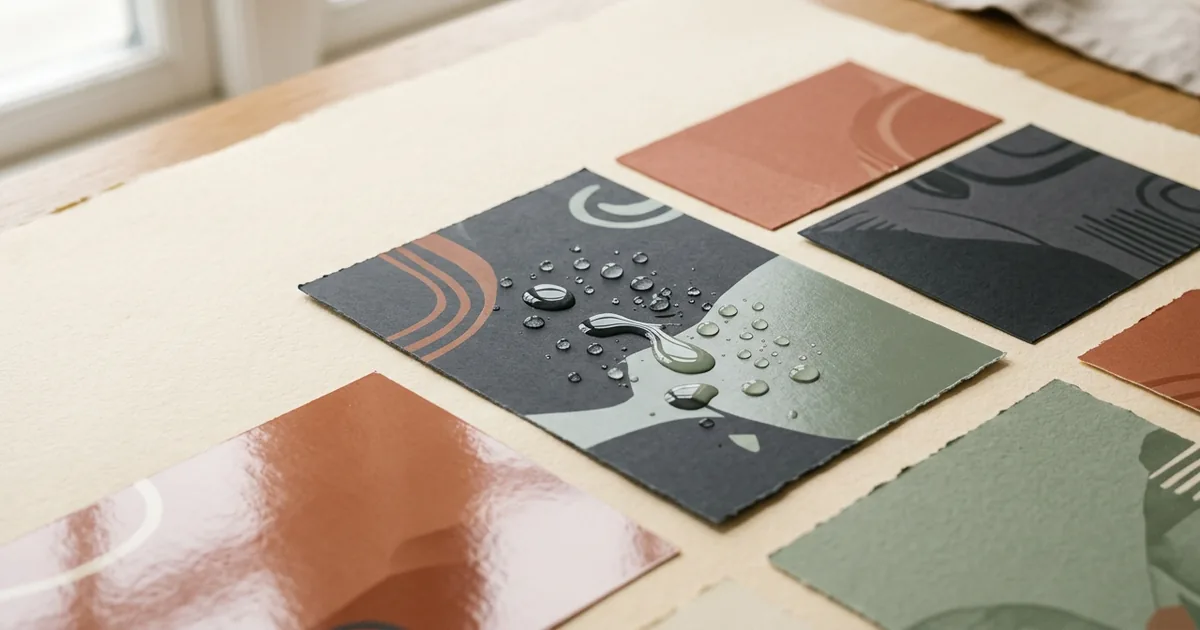
Lamination bonds a thin plastic film to the printed sheet and offers the strongest protection against moisture, tearing and wear, while varnish is a thinner ink-based coating applied during printing that adds shine and light protection at a lower cost.
What varnish is
Varnish is essentially a clear ink, applied either as an overall coating across the whole sheet or as a spot varnish over specific areas, and cured in-line as part of the printing process. It's the lightest-touch of the two finishes, adding some shine or matt effect and modest resistance to fingerprints and light handling, but it doesn't create a physical barrier in the way a laminate film does.
What lamination is
Lamination applies a separate plastic film — gloss, matt, or soft-touch — to the printed sheet using heat and pressure, as an additional step after printing. Because it's a genuine physical layer rather than a coating of ink, it offers significantly more protection against moisture, scuffing, and general wear, which is why it's the standard choice for menus, book covers and anything expected to be handled repeatedly over a long period.
Comparing the two
| Feature | Varnish | Lamination |
|---|---|---|
| What it is | Clear ink coating | Bonded plastic film |
| Protection level | Light — resists fingerprints, minor handling | Strong — resists moisture, tearing, heavy use |
| Cost | Lower, often included in print run | Higher, added as a finishing step |
| Recyclability | Easily recycled with paper | Can complicate paper recycling |
| Typical uses | Posters, brochures, general marketing | Menus, covers, business cards, packaging |
Gloss, matt and soft-touch lamination
Gloss lamination gives maximum shine and colour vibrancy, and is the most resistant to visible scuffing since marks are less noticeable on a reflective surface. Matt lamination gives a smooth, non-reflective finish that many people associate with a more premium, understated look, though fingerprints and light scuffs can show slightly more than on gloss. Soft-touch lamination adds a velvety texture that feels distinctive in the hand, often used on premium packaging and covers, though it can show fingerprints more readily than either gloss or matt.
Which should you choose?
If a piece is mainly seen rather than handled repeatedly — posters, most brochures, one-off flyers — varnish is usually sufficient and more cost-effective, since it protects against basic handling and adds a nice finish without the added cost and environmental complexity of a plastic layer. If a piece will be handled frequently, exposed to moisture, or needs to last a long time — menus, book covers, membership cards, box packaging — lamination is generally worth the extra cost for the durability it adds.
A note on recyclability
Laminated paper is harder to recycle through standard paper streams because the plastic film has to be separated from the fibre, which isn't always possible at every recycling facility. Varnish, being ink-based rather than a separate plastic layer, doesn't create the same complication. If sustainability messaging matters to your brand, this is worth factoring in alongside durability needs.
The short version
- Varnish: ink-based, lighter protection, lower cost, easier to recycle
- Lamination: plastic film, strongest protection, higher cost, harder to recycle
- Choose varnish for items that are seen more than handled
- Choose lamination for menus, covers and anything needing long-term durability