
For short-term, low-cost signage such as estate agent boards or event direction signs, Correx is the right material. For a general-purpose sign that needs to look smart and last a season or two, Foamex is the best balance of price and quality. For a premium, long-life outdoor sign that will face years of weather, Dibond is worth the extra cost.
What the three materials are
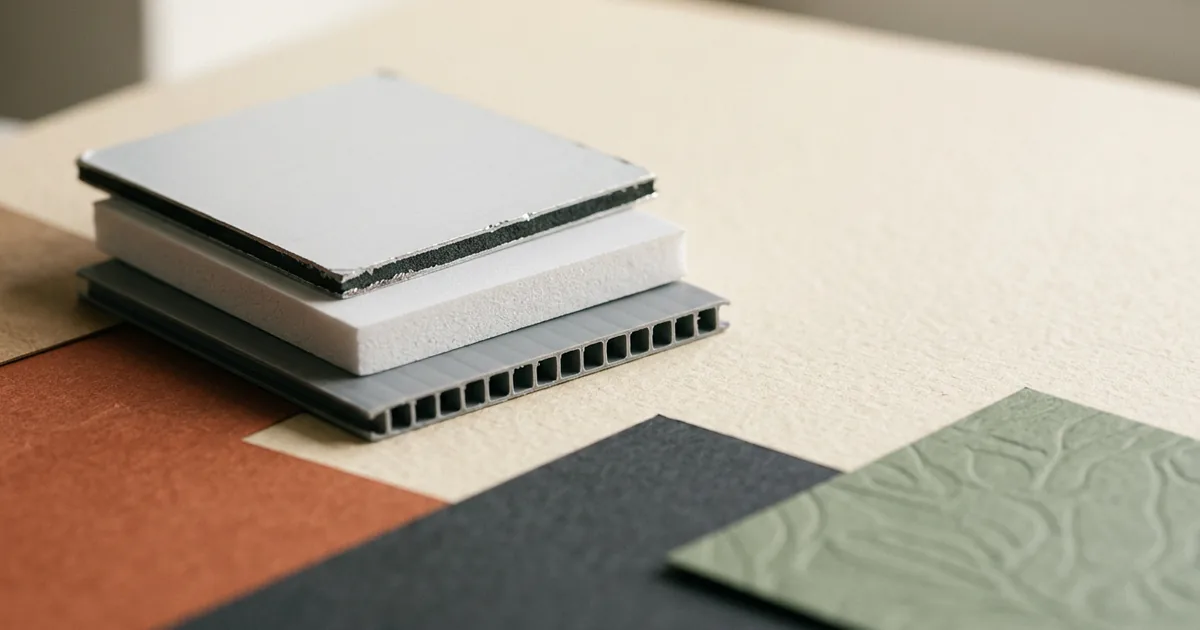
Correx is a fluted, corrugated plastic sheet, similar in structure to cardboard but made from polypropylene, which makes it lightweight and weatherproof but easy to dent or bend. Foamex (also called foam PVC) is a rigid, closed-cell PVC board with a smooth, solid-feeling surface. Dibond is a composite panel made from two thin aluminium sheets bonded either side of a solid polyethylene core, giving it real rigidity and a premium, flat finish.
Comparing the three
| Material | Typical thickness | Weight | Rigidity | Outdoor lifespan | Relative cost |
|---|---|---|---|---|---|
| Correx | 4-5mm | Very light | Flexible, bends easily | Weeks to a few months | Lowest |
| Foamex | 3-10mm | Light to moderate | Rigid, holds flat | 1-3 years | Mid-range |
| Dibond | 3mm composite | Moderate, denser feel | Very rigid, resists warping | 5+ years | Highest |
Where each one makes sense
Correx
Correx's fluted structure makes it cheap to produce in bulk and easy to cut into custom shapes such as arrows or estate agent boards. It's the standard choice for election campaign boards, temporary site signage, and stake-mounted directional signs at events, precisely because it's disposable: nobody minds if a £5 Correx sign gets scuffed or blown over. It's not the material to choose if you want a sign to survive a whole summer of direct sun without the surface starting to look tired, since UV exposure fades it faster than the other two.
Foamex
Foamex sits comfortably between disposable and permanent. Its smooth surface takes print well and holds a flat, professional finish, and because it's rigid it doesn't need a frame for many applications – it can simply be screwed, wall-mounted or displayed on a stand. It's a common choice for shop window displays, exhibition panels, estate agent boards where a longer life is wanted, and internal directional signage. It's UV stable enough for a year or two outdoors but will eventually show some fading and, in thinner sheets, can warp slightly in sustained heat.
Dibond
Dibond's aluminium skin makes it the most weather-resistant and dimensionally stable of the three: it won't warp, sag or absorb moisture, and its finish looks genuinely premium, closer to a metal sign than a plastic one. This is the material for building signage, car park signs, permanent outdoor way-finding and anything mounted where replacing it in a year isn't practical. The trade-off is cost and weight – it's heavier to install and needs proper fixings rather than simple stakes.
A few practical notes
- All three can be printed full colour and cut to custom shapes, including holes for cable ties or stand-off fixings.
- Correx signs for outdoor stakes typically use a flute orientation that lets a support rod slide inside the board.
- Foamex and Dibond both accept vinyl lettering or direct print equally well.
- If a sign will be handled or moved often (estate boards swapped between properties), Foamex's lighter weight is an advantage over Dibond.
The short version
- Correx: cheapest, lightest, best for temporary or short-term signs.
- Foamex: rigid, smooth, good all-rounder for a year or two of use.
- Dibond: premium, weatherproof, the choice for long-term outdoor signage.
- Pick based on how long the sign needs to last, not just budget.