
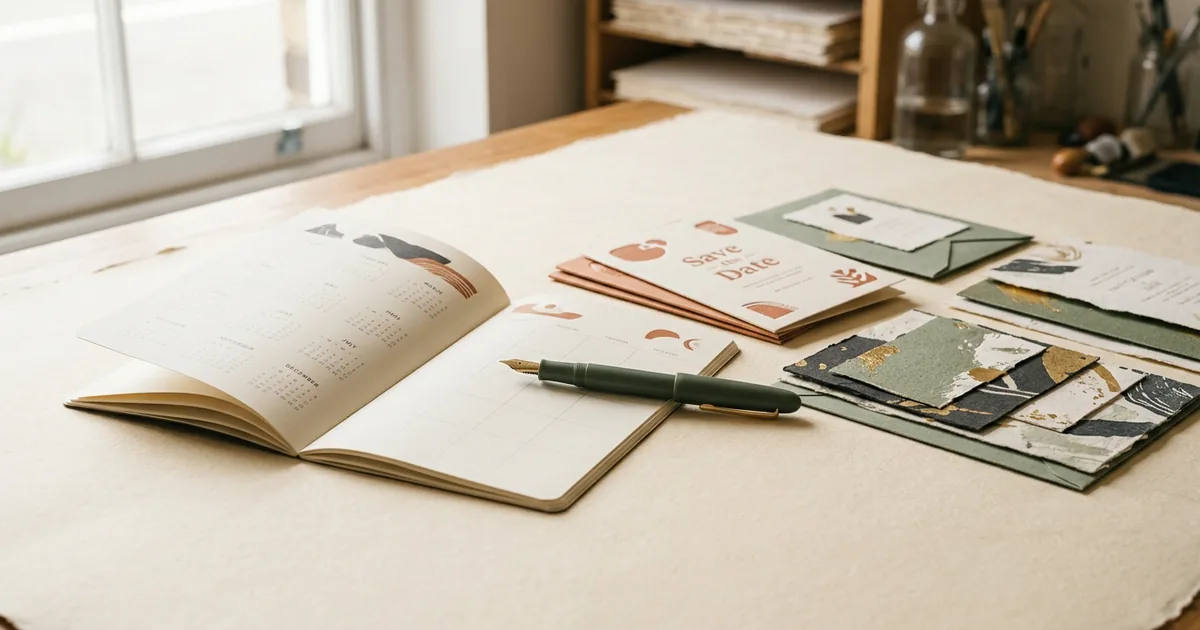
As a rough guide, order save-the-dates around ten to twelve months before the wedding, invitations five to seven months out, and finalise on-the-day stationery such as order of service sheets, table plans and menus around three to four weeks before, once your final numbers and seating are confirmed. Working backwards from the day itself, with buffer time at each stage for proofing and guest replies, avoids the last-minute scramble that catches a lot of couples out.
Why timing matters more with stationery than almost anything else
Unlike flowers or catering, stationery has a knock-on deadline: guests need enough notice to plan around your date, book time off work or arrange travel, especially for a wedding abroad or over a bank holiday weekend. Leave save-the-dates too late and you lose the flexibility they are meant to provide. At the other end, on-the-day items depend on information — final guest numbers, table allocations, running order — that genuinely is not settled until close to the date, so ordering those too early just means reprinting later.
The full timeline
| Time before wedding | Stationery to order | Notes |
|---|---|---|
| 10–12 months | Save-the-dates | Especially important for destination weddings or peak season (May–September) dates |
| 8–9 months | Finalise invitation design and wording | Confirm venue details, RSVP method and dress code before ordering |
| 5–7 months | Invitations, RSVP cards | Send with 6–8 weeks for guests to reply before your catering deadline |
| 3–4 months | Order any signage that doesn't depend on final numbers | Welcome signs, directional signs, table number designs |
| 6–8 weeks | RSVP deadline passes; confirm final guest count | Chase any outstanding replies now |
| 3–4 weeks | Order of service, table plan, place cards, menus | Now that seating and numbers are locked in |
| 1–2 weeks | Collect or receive final print, do a full check | Check names, table numbers and running order for typos |
Building in proofing time at every stage
Every item on this list benefits from at least one proof stage before the full order goes to print, and it is worth budgeting a few extra days for this at each step rather than treating the lead times above as start-to-finish totals. A proof lets you catch a misspelled name, a wrong date format or a colour that looks different in print to how it looked on screen — all far easier to fix before printing than after.
Save-the-dates: the exception to plan for early
Save-the-dates are the one item where earlier is almost always better, particularly if your wedding falls in peak UK wedding season (May to September) or over a long weekend, when guests are more likely to have competing plans. If you are getting married abroad, push this even earlier — twelve months is a sensible minimum to give guests time to look at flights and annual leave.
Invitations: balancing detail against deadlines
Invitations need more information locked down than save-the-dates — venue, timings, dress code, gift preferences, RSVP method — so they naturally go out later. Aim to have your invitations in guests' hands with at least eight weeks before your RSVP deadline, and set that deadline with enough buffer before your caterer needs final numbers, since replies rarely all arrive on time.
On-the-day items: last, but not left too late
Order of service sheets, table plans, place cards and menus should be the very last things you finalise, because they depend on details that only settle close to the day: final guest count, table allocations, any last-minute running order changes. Three to four weeks out is normally enough time to design, proof and print these once numbers are confirmed, but check turnaround times with your printer if you are choosing a more involved finish.
The short version
- Save-the-dates: 10–12 months out, earlier for destination weddings.
- Invitations: 5–7 months out, giving guests 6–8 weeks to RSVP.
- On-the-day stationery: 3–4 weeks out, once numbers and seating are confirmed.
- Build proofing time into every stage — it is far cheaper than a reprint.